Vision often feels self-evident. You open your eyes and the world is there. Only when the image becomes blurry does the question arise: what is actually happening with the eyes? Why does one person see well in the distance but not up close? Why does one eye see worse than the other? And how do lenses or glasses correct all of this?
Eye optics are not mysterious or overly complex. Once you understand the basic principles, making decisions related to vision becomes much easier.
The Eye as an Optical System
The eye works in a similar way to a camera. Its task is to direct light so that the image is focused in exactly the right place. When all parts work together, vision is clear and comfortable.
The optical system mainly consists of three steps:
light must enter the eye,
it must be refracted correctly,
and finally, the information must reach the brain.
If any of these steps is not precise, the result is a blurry or uncomfortable image.
The Path of Light Into the Eye
Everything begins with light. When you look at an object, light reflects from it and enters the eye through the cornea. The cornea is a transparent, curved surface that plays a major role in bending light.
The light then passes through the aqueous fluid, the pupil, and the eye’s natural lens. The pupil controls how much light enters the eye. In bright conditions it becomes smaller, and in dim light it becomes larger.
The eye’s lens helps focus the light accurately. Eventually, the light reaches the retina, where an image is formed. This information then travels along the optic nerve to the brain, where the image is “assembled.”
Vision does not happen in the eyes themselves, but in the brain. The eyes collect information; the brain creates the image.
What Does Sharp Vision Mean in Optical Terms?
Sharp vision means that light is focused precisely on the retina. If the focus falls in front of or behind the retina, the image becomes blurry.
When the focus is in front of the retina, it is called myopia (nearsightedness). When the focus is behind the retina, it is hyperopia (farsightedness). Both are optical refractive errors.
They do not mean that the eye is “sick.” They simply mean that the optical system does not bend light exactly as needed.
Why the Shape of the Eye Affects Vision
Not all eyes have the same shape. Some eyes are slightly longer, others shorter. Some corneas are perfectly round, others slightly oval.
These small differences determine where light is focused. If the eye is too long, light reaches the retina too early. If the eye is too short, light reaches it too late.
In the case of astigmatism, the eye does not refract light evenly in all directions. As a result, the image may appear stretched or shadowed.
All of these are optical characteristics, not flaws. The right correction helps balance them.
How Glasses and Lenses Correct Eye Optics
Glasses and lenses change the path of light before it enters the eye. They support the eye’s optical system.
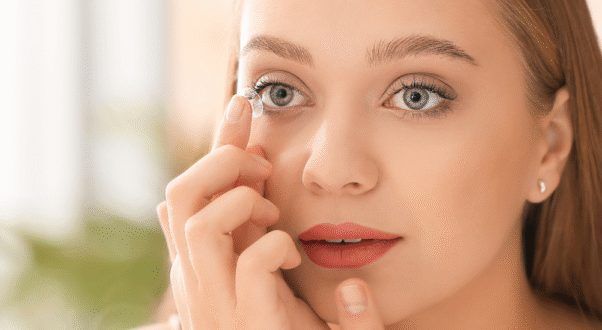
Glasses sit at a distance from the eyes and affect light more broadly. Contact lenses sit directly on the surface of the eye and move with it. This is why their effect is often more precise, especially when there is a difference between the two eyes.
Contact lenses allow each eye to be corrected individually, which is very important from an optical perspective.
Why One Eye May See Worse Than the Other
Optically, this is very common. One eye may have more minus power, the other more plus. One eye may have astigmatism, while the other does not.
The brain tries to balance the image, but this requires extra effort. By the end of the day, fatigue sets in, even if the person does not immediately realize why.
In such situations, lenses often provide better balance, because each eye receives the correction it specifically needs.
How Age Affects Eye Optics
With age, the eye’s natural lens becomes stiffer. In youth, the lens is elastic and adapts quickly. Over time, it becomes less flexible.
As a result, seeing up close becomes more difficult. This is not a disease, but a natural optical change. At first, it is noticeable when reading, and later when using a phone or computer.
From an optical standpoint, this means the eye can no longer change focus as easily. Multifocal lenses help direct light correctly at different distances.
Why Screen Work Affects Vision Optics
When working on a screen, the eyes remain focused at a single distance for long periods. This means the eye muscles stay constantly tense, and the optical system gets no variation.
When dry air and infrequent blinking are added, the surface of the eye becomes unstable. Light scatters unevenly, and the image appears blurrier.
Proper correction and suitable care products help keep the optical system more stable throughout a long workday.
Why Contact Lenses Can Provide Clearer Vision
From an optical point of view, the reason is simple. Contact lenses sit exactly where light enters the eye. They move with the eye and do not create additional reflections.
This allows light to be refracted more evenly. The image appears more natural, the field of view wider, and contrast improved.
This difference is especially noticeable in low light and during movement.
Why Care Affects Vision Quality
If a lens is not clean or the eye surface is dry, light is not refracted evenly. Optically, this means the image becomes unstable.
That is why care products are an important part of visual comfort. A clean eye surface and a smooth lens allow light to focus correctly.
This is not only about hygiene, but directly related to optical quality.
When Vision Definitely Needs Checking
If you notice that:
-
the image is no longer even
-
one eye becomes tired more easily
-
vision in low light feels uncomfortable
-
frequent headaches occur
-
the eyes do not seem to work together
then it is worth having your eye optics checked. Often, a small adjustment in correction is enough to make vision significantly more comfortable.
Eye optics are not something to fear or consider overly complicated. They are a system designed to work together with light.
If something does not feel comfortable, it is not an unavoidable normality. It is a sign that vision can be better balanced.
Properly chosen glasses or contact lenses do not only change what you see. They also change how you feel throughout the day.